Patch note, 20 September 2026 (Beta)
A record of what changed on this day, imported from the announcement as it was written. It is not kept up to date: for how the game works now, read the page for the thing itself. See all patch notes.
This patch goes out as a public Beta. It is the largest single change to the game in years – the loot system, the item sets, the vengeful system, crafting and the world map have all been rebuilt, and a lot of it has never been played by anyone but us. Please play it, break it, and tell us what you find. Expect rough edges, expect further tuning, and expect us to patch quickly while the Beta runs.
Before you log in
- Every trade post listing is returned to its seller. The item rework changes too much for a listing to survive it – a price agreed against the old shape of an item would be a bid on a description that no longer matches what you would get. Every live listing is handed straight back to the seller's vault and the row is dropped, so the trade post opens empty and everyone relists against what they actually hold. Items already sold are not returned; your Sold and Bought history is kept
- Your items are converted where they need to be. Old crafted wands and potions, the retired ATS unique gear, old pelts and leather, and every item that gained a tier flag have been migrated. A vengeful ATS unique is deliberately left exactly as it is – it keeps what it rolled. Leather holdings are split evenly across the six new grades and the extra grades are deposited straight into your vault. More details below.
Item Tiers
Everything that grades an item now reads one number, its tier. Loot, the trade post, the black market, the scrap forge, set bonuses, vengeance and pickpocketing all key on the same ladder.
| Tier | What sits there | Colour |
|---|---|---|
| 1 | ordinary gear | no colour |
| 2 | some brilliant items | green |
| 3 | nordock relics, socketables, some brilliant items | cyan |
| 4 | epic ("purple") items, some brilliant items | purple |
| 5 | legendary items | orange |
| 6 | a legendary that is vengeful or masterful | crimson |
Brilliant items are not one tier. They sit at 2, 3 or 4 depending on the item, which is exactly why the old quality flag could not grade them and the tier can.
The tier is not just a colour. It is now the number that decides:
- what your set bonuses give you, and whether the item counts towards them at all;
- what a vengeance roll costs, and how good the outcomes on offer are;
- what the Scrap Forge pays for it;
- whether a pickpocket can take it off you;
- how it filters and sorts on the trade post.
So one number now answers "how good is this", and every system gives the same answer.
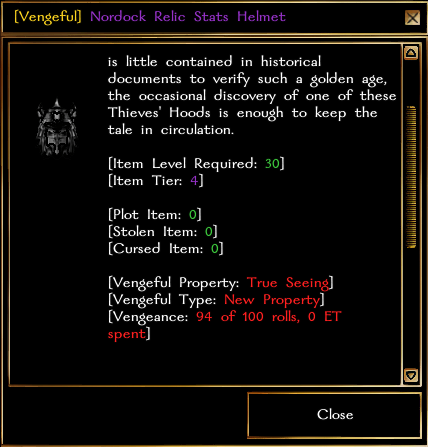
- An item's name is painted in its tier colour, so you can read the grade of a drop at a glance without examining it. A vengeful or masterful item counts one tier higher than the item it was made from, and carries a gold [Vengeful] or [Masterful] tag in front of its name.
- Examining an item now tells you its tier, on the line under its level requirement, along with its plot, stolen and cursed flags.
- Hundreds of items across the module were renamed, recoloured, re-flagged and moved between palettes to sit on the right rung. Loot tables were rebuilt around the same ladder: a new level 21+ table for the nordock line, base tables 1 to 5 adjusted, and the epic table reworked. The reworked nordock and epic gear now drops unidentified.
- Mounts, pets and skins are coloured on the same ramp, so a rare mount reads as rare in the list.
- The trade post rarity filter is now a tier filter, and reads the tier off the item itself.
- The Black Market is coloured by item tier rather than by eye.
Unique and Boss drops
Uniques and bosses now get a drop pass of their own, and it scales with where you are rather than with a hand-kept list. Uniques roll on the gem table; bosses fought outside a dungeon roll Epic Tokens – inside one they already do.
Inside a dungeon, the chance follows the dungeon's level band:
| Dungeon | Chance |
|---|---|
| Low level | 50% |
| Level 21+ | 75% |
| Level 40+ | 100% |
| Raid | 100%, rolled twice |
Outside a dungeon it follows the creature's Challenge Rating instead, which is what finally makes a world unique worth hunting:
| Challenge Rating | Chance |
|---|---|
| 50 and above | 100% |
| 30 to 49 | 75% |
| 20 to 29 | 50% |
| below 20 | 25% |
The Scrap Forge
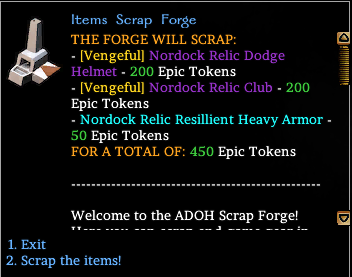
The Scrap Forge now pays a flat rate per item tier instead of guessing at a percentage, and it tells you what it is going to pay before you confirm.
| Tier | Pays |
|---|---|
| 2 | 10 Epic Tokens |
| 3 | 50 |
| 4 | 200 |
| 5 | 600 |
| 6 | 1200 |
- Opening the forge now prints a full quote: one line per item it will pay for, what each one is worth, and the running total. Items it will not buy are left out of the list, for the same reason it leaves them in the container – it is not touching them.
- The forge no longer opens for gear it would then refuse to buy.
- Tier 1 items are worth nothing, which is what keeps vendor trash out of the forge.
- Socketable gems keep their old rule and pay a share of their table price.
- An item still holding gems is refused outright rather than being melted down with them inside. Pull your gems back out first.
- Only equippable items can be scrapped. Ammunition and thrown weapons must arrive at a full stack (99 and 50 respectively) or they are not eligible.
- Crafted GTS goods are never scrapped – their materials are gathered rather than found, and they have their own economy through the Trade Hall.
Vengeance, Rebuilt
The vengeful system has been rewritten from the ground up around one weighted outcome pool, with a UI window of its own.
The roll window
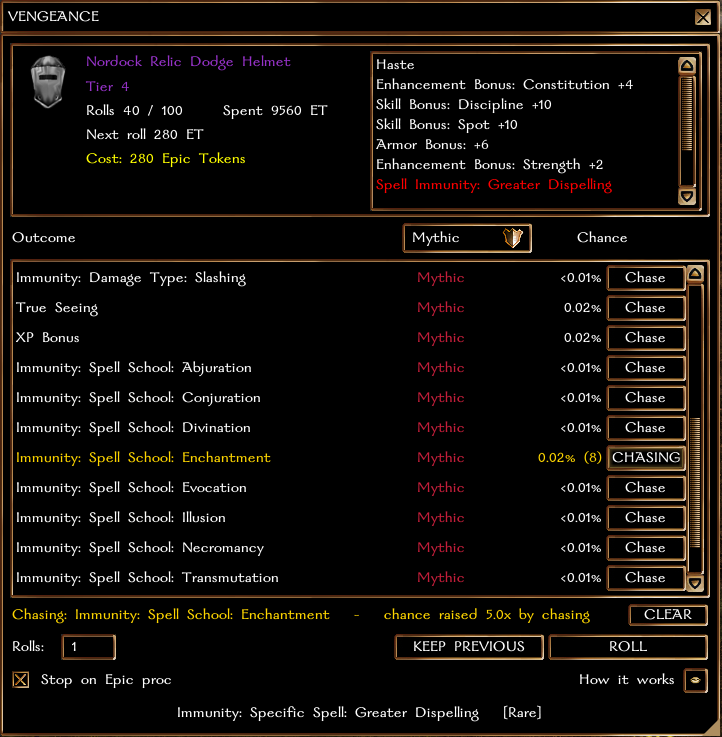
Target an item with your vengeance tool, and you now get a window instead of a conversation. It shows you the entire pool of outcomes you could roll, with the odds, and the odds shown are the same call that the roll itself makes.
- Pick an outcome to chase. Click a row to nominate it, click it again to let it go. One preference per item.
- Chasing raises your odds. Every miss adds to the chance of what you are chasing, up to five times its base weight. The window tells you the multiplier you are on – "chance raised 3.0x by chasing". Switching targets parks that raised chance rather than spending it.
- Batch rolls. Ask for several rolls at once and they resolve in one go. A batch stops early if it lands something good, at or above a set rarity band for the item's tier, even when it is not what you picked, so nobody burns past a great outcome. A checkbox turns that off.
- Going back one roll. If a roll replaces something you would rather have kept, you can put the previous outcome back, for the price of a roll. One step only, going further has to be earned, and any new roll clears it.
What a roll can give you
- Outcomes are sorted into five rarity bands – Common, Uncommon, Rare, Epic, Mythic – weighted per result tier. Nothing is hard-gated. Even the lowest result tier rolls Mythic about once in five thousand; on a legendary it is about one roll in seventy-five.
- The result tier is the item's tier plus one. A legendary rolls on the tier 6 table.
- Upgrading what you already have takes a fixed 35% share of the pool, split across whatever the item can still improve. New properties take the rest.
- Every property has a floor as well as a ceiling per tier, so a tier 6 grant cannot hand you SR 10 or a +1 AC. Within the range the floor is the ordinary roll and the ceiling is the prize.
- A property with no legal value at your tier is simply not offered, which is how the strong entries gate themselves.
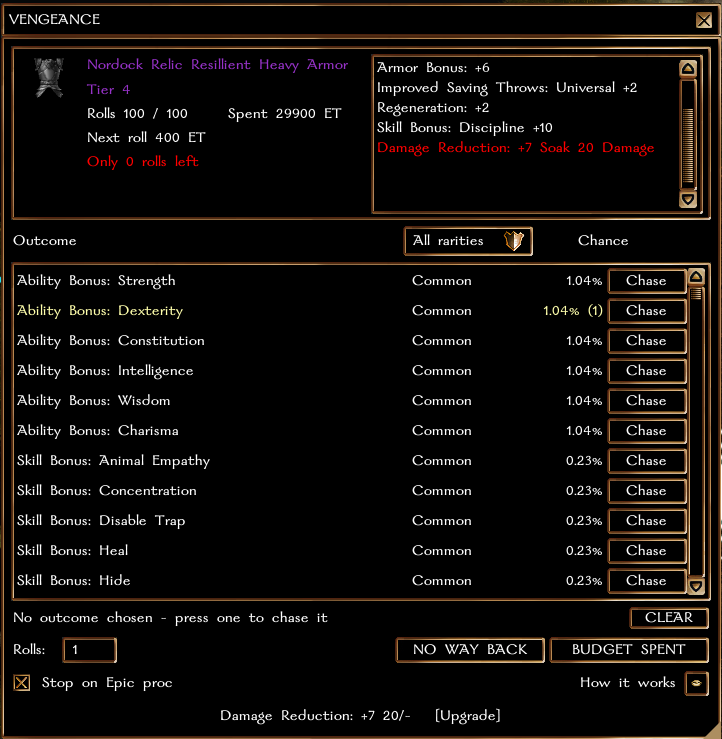
- 100 rolls per item, ever. Roll 1 is the first vengeance. Common and Uncommon targets are effectively certain over a full budget; Epic and Mythic stay a gamble.
What it costs
Price is set by the item's source tier, in Epic Tokens:
| Item tier | Per roll |
|---|---|
| 1 | 50 |
| 2 | 100 |
| 3 | 200 |
| 4 | 500 |
| 5 | 1000 |
- The first vengeance also consumes one other copy of the item, down from the old requirement. Rerolls are tokens only.
- Note the shift: a normal item used to cost a flat 4000 Epic Tokens just to make vengeful, and rerolls were cheap. The money has moved out of the entry fee and into the chase.
- The old NORD / GREEN / 2-copy / 4-copy options are gone. Any compatible item, one copy, price from its tier.
Everything else about it
- Examining a vengeful item now shows its history – the property, whether it was a new grant or an upgrade, how many of its 100 rolls are spent and how many Epic Tokens have gone into it.
- A vengeful socketable gets an extra socket instead of a rolled property. Its level requirement does not change.
- Sequencer robes can be made vengeful now. That exclusion is gone.
- Damage ladders retuned, and scaled by tier. Damage resistance and damage reduction run 5-15 / 5-15 / 5-20 / 10-25 / 10-30 across tiers 2 to 6; damage immunity 5-10 / 5-10 / 5-15 / 10-20 / 10-25. All of them came down. A property already at or above its new tier cap simply stops being offered – nothing on an existing item is taken away.
- Damage Reduction's damage power now scales with tier (+5/+6 at tier 2 up to +9/+10 at tier 6), instead of a flat pick where a tier 2 item could roll the strongest as easily as the weakest.
- Spiked Surface can now roll Bludgeoning, Piercing and Slashing alongside the five elemental types.
- Immunity to a specific spell could never actually be granted before. It can now – a whole Rare-band family that was unreachable. Which spells are on offer narrows by tier, so the ones worth blocking sit at the top of the ladder.
- A grant can no longer overwrite something better. New properties now exclude anything the item already carries; improving those is what the upgrade entries are for.
- Outcomes are described in the units you read:
2d12,+13,SR 24,4 hp/round, rather than a raw table number. - Proc spells from a vengeful property roll spell resistance at your own Hit Dice, capped by item tier (20/25/30/35 for tiers 2-5, uncapped at tier 6).
What happens to the vengeful items you already have
They keep the property they rolled. The old system stored a vengeance as four loose values on the item; those are converted into the new record on login, and the item comes through carrying exactly what it carried before.
Two things are worth knowing once it has converted:
- Your first roll on a converted item costs no Epic Tokens. It still counts as one of the hundred, but you can see the new pool and take a swing at it without paying.
- The 100-roll budget is per item and permanent – there is no way to reset it, and it counts every roll including the free one. An item you have chased hard is a finished item, and that is the point: the budget is what stops one legendary absorbing an unlimited number of tokens.
Item Sets, Rebuilt
The old set system, with its class families and its per-set lists, is gone. Item sets are now driven entirely by tier.
- Any three or more equipped items activate set bonuses. There is no pure-class requirement, no set family and no vengeance requirement any more. You no longer hunt a named set – you wear good gear, and the set follows.
- Each item's effective tier is the highest tier at which you have three or more items. Mixing a low-tier piece into high-tier gear costs you on that piece, not on the set.
- Six tiers of bonuses. The tier 4 caps hold through tier 5, and tier 6 deliberately breaks all of them: +4 enhancement and attack, +4 AC, 25% damage immunity, +12 skills, +4 saves.
- The set now tells you when it comes online. A message floats the group and the tier whenever a higher tier activates.
The effective-tier rule is worth an example. Wearing four tier 4 pieces and one tier 2 piece, the four resolve at tier 4 and the odd one out resolves at tier 2 – it still contributes, just at its own level. Swap that last piece up to tier 4 and all five move together. Three is the number to remember: below three at a given tier, nothing pays out at that tier at all.
Which set you get is decided by your major class – the class you have the most levels in. There are nine groups:
| Group | Major class |
|---|---|
| Archer | Ranger, Arcane Archer, Elite Guard |
| Agile | Rogue, Monk, Assassin, Shadowdancer, Weapon Master |
| Fighter | Fighter, Barbarian, Dragon Disciple, Northern Templar |
| Diviner | Cleric, Paladin, Blackguard, Divine Champion, Purple Dragon Knight |
| Arcanist | Wizard, Sorcerer |
| Support | Bard, Skald, Harper |
| Shifter | Druid, Shifter |
| Tank | Dwarven Defender, Pale Master |
| Warlock | Warlock |
Change which class you have the most levels in and your set changes with it, so a heavy dip is now a decision about your set bonuses as well as your build.
Slot and group changes
- Every group ends up with two skill bonuses and three damage immunities. The third immunity sits on the gloves for Archer, Agile, Fighter, Arcanist and Shifter, and on the boots for Diviner, Support, Tank and Warlock – that slot trades its skill for it, and the belt carries the displaced skill at every tier and adds a knockdown ward from tier 3.
- Helmets carry a saves curve. Archer, Agile, Support and Warlock swap it for death magic immunity from tier 3 up – it replaces the saves rather than stacking with them.
- Arcanist loses its arcane spell failure reduction; its weapon now carries two bonus spell slots of the same level instead, plus a spell slot on the off-hand piece. Support's amulet is now the only arcane spell failure source in the system.
- Weapon procs: Fighter gets Ground Smash, Diviner gets Divine Blast, both at every tier. Fighter's old massive-criticals ladder is gone.
- Classic on-hit effects: Archer = Silence, Agile = Blindness, Shifter = Doom (was Slow, which never fired).
- Archer tier 5 and 6 signature is Sundering Volley, a proc on its own chance ladder (12% at tier 5, 16% at tier 6), on top of the Silence on-hit.
- Agile tier 5 and 6 signature: Improved Evasion on the boots, or pure weapon damage (1d6 at tier 5, 2d6 at tier 6) if you already have the feat.
- Support gets a new property instead of a proc: Cries of the Soul, which strengthens your own Bard Song pool and the Curse Song damage branch. One rank per effective tier of the weapon carrying it.
- Death immunity is gated at tier 3, and the belt is kept useful below tier 4 with a permanent skill bonus.
The ADOH Atlas
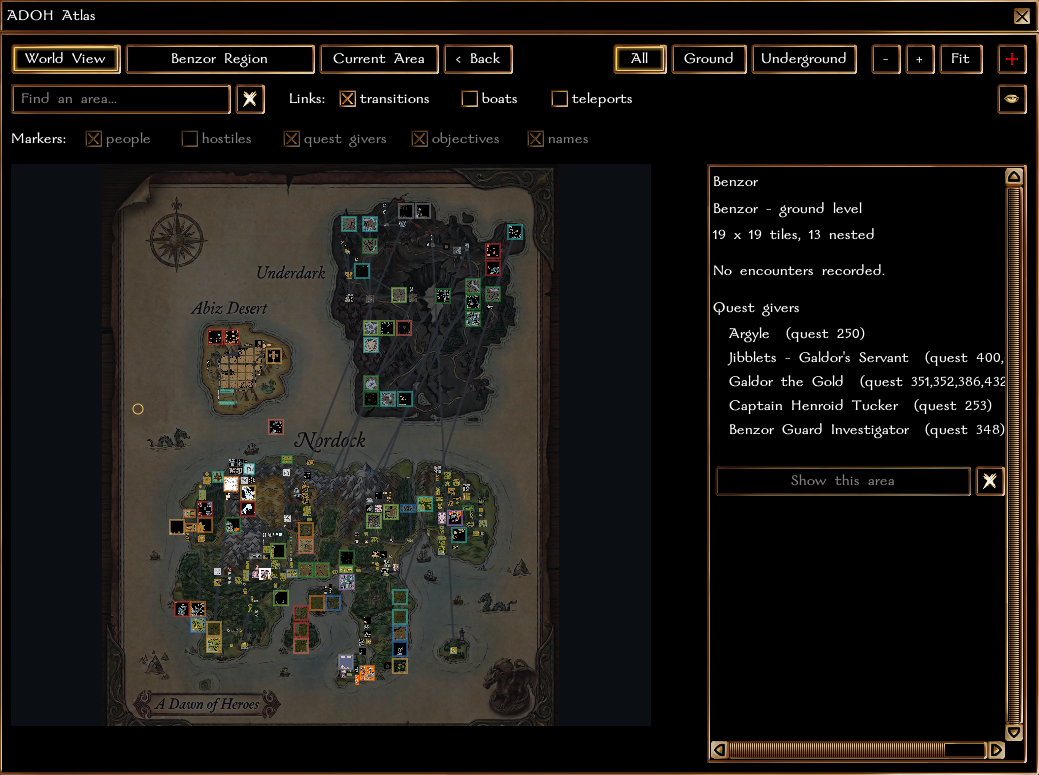
Both the website map and the in-game minimap have been replaced by a custom world map. Open it exactly as you always did – the map key, M on desktop – and you get the Atlas instead.
Three views
- World View shows the whole world, every area drawn as its own map picture, laid out at its true size. Half the world map had no art at all and has been drawn for this patch.
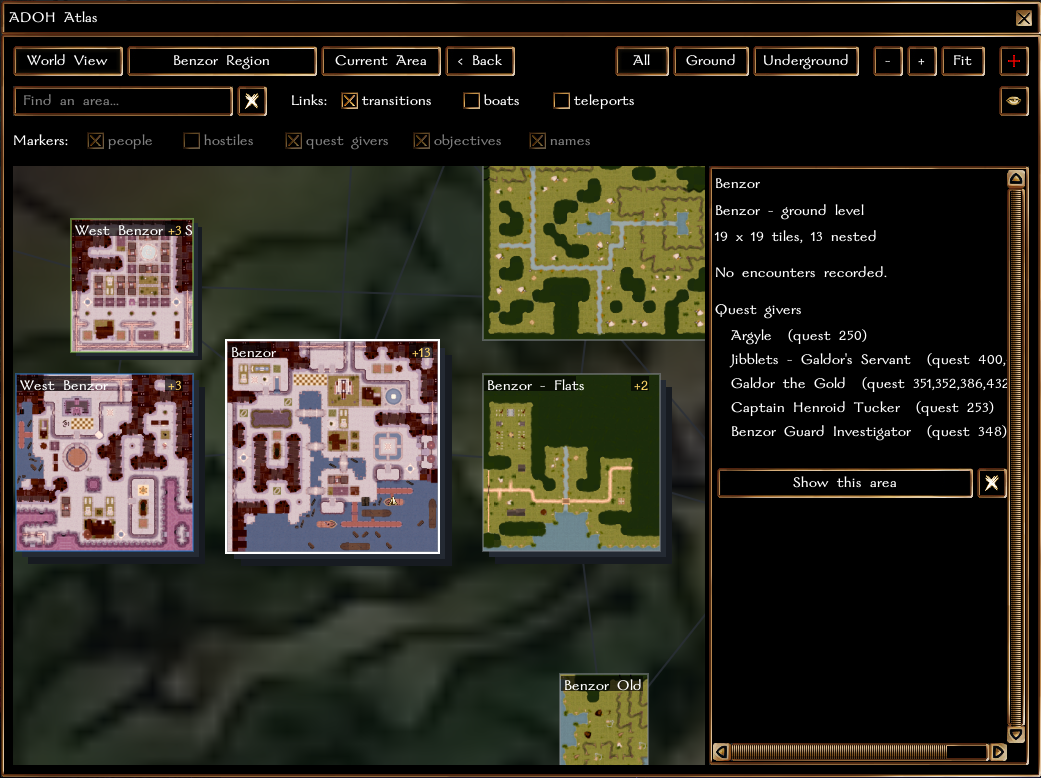
- Region shows one region close up.
- Current Area shows the room you are standing in, and follows you as you walk through doors.
- Back is a history, not a step up the map, it returns you to wherever you were looking before.
Getting around
- Drag to pan. The mouse wheel zooms around the cursor; - and + zoom around the middle. Fit jumps to where your character is standing.
- Search by name and click a result to centre the map on it.
- Click any area to select it. The panel on the right tells you its size, whether it is underground, its danger rating and who gives quests there. Show this area opens it.
- Select two areas and the map works out a route between them – naming each hop, what it costs and who may take it. Boat crossings that your character cannot take are excluded, so you are never routed onto a ship that will turn you away.
What you see on it
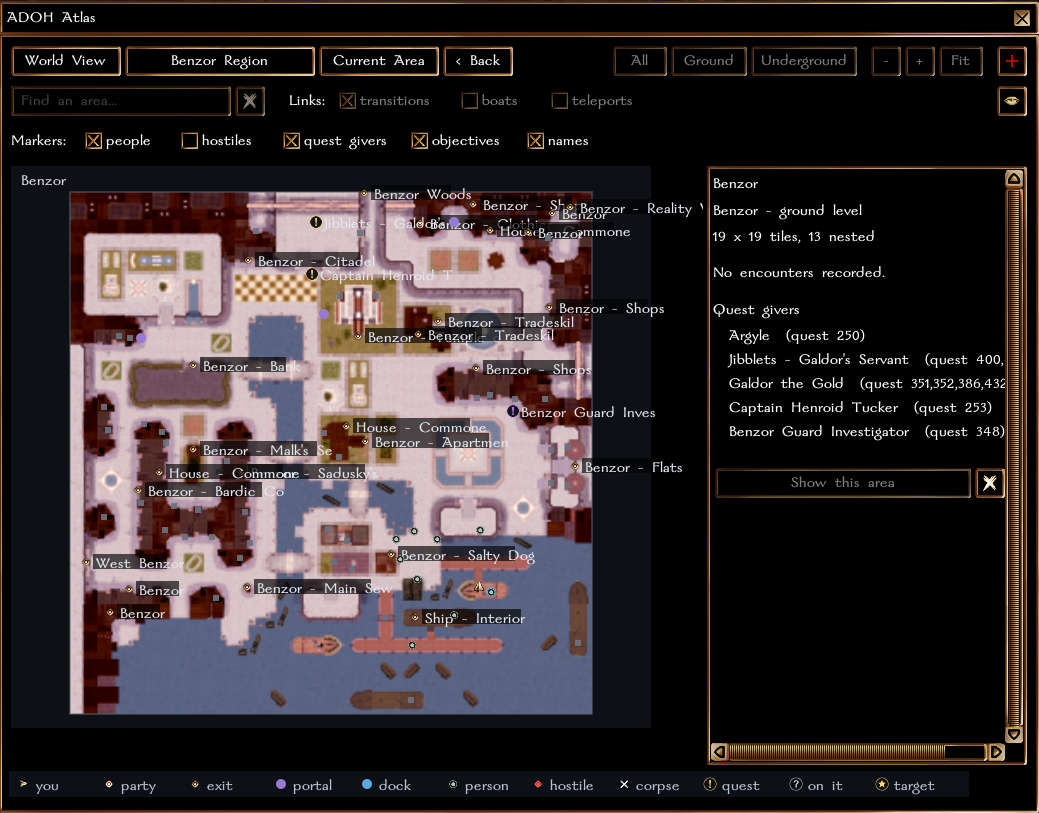
- The gold arrow is you, and it points the way you are facing. Diamonds are your party: pale for other players, blue for henchmen, familiars and summons.
- Gold diamonds are ways out – doors and area transitions. Purple circles are portals, blue ones are boat docks.
- Red diamonds are hostiles your character can actually see or hear, and a white X is a corpse. Both behind a tick box.
- Green dots are quest givers.
- Quest markers use the same marks people wear over their heads out in the world, so the map and your eyes agree:
!for work available (gold ordinary, purple main quest, red too low a level, blue repeatable),?for a quest you are on (green go and speak, silver still something to do, gold ready to hand in), a star for something to kill, a diamond for something to destroy and rings for somewhere to search. - There are no hover tooltips. Click any marker and its name appears along the bottom of the map; click again to clear it.
- Lines between areas: grey is an ordinary walk, blue a boat, red a portal, gold a journey someone arranges for you. Each kind has its own Show box.
- Fog works similarly to the old minimap, anywhere you have not been is blacked out, and walking there reveals it permanently. Fog is per character; every other preference is saved for your whole account.
Where the map does not match the world
Some areas sit on the map in a direction that does not match the way you walked into them. The toolset records no compass bearing for an area, so nothing in the module says which edge of a map is north; every transition had to be placed by hand and read back from the world. Where the world itself disagrees with itself - you leave an area by its east edge and arrive at the west edge of somewhere that sits north of it - the map can only show one of the two, and it shows the connection rather than inventing a bearing.
We found this out late, with the layout already drawn, so it is still there: most of the original nordock areas and a good number of the ones added since are affected. The route finder, the fog, the markers and every distance the map quotes are unaffected - it is the placement of some areas relative to each other that reads oddly. Straightening it means re-anchoring areas one at a time against the world, and that is work for a later patch rather than a reason to hold this one.
The small map
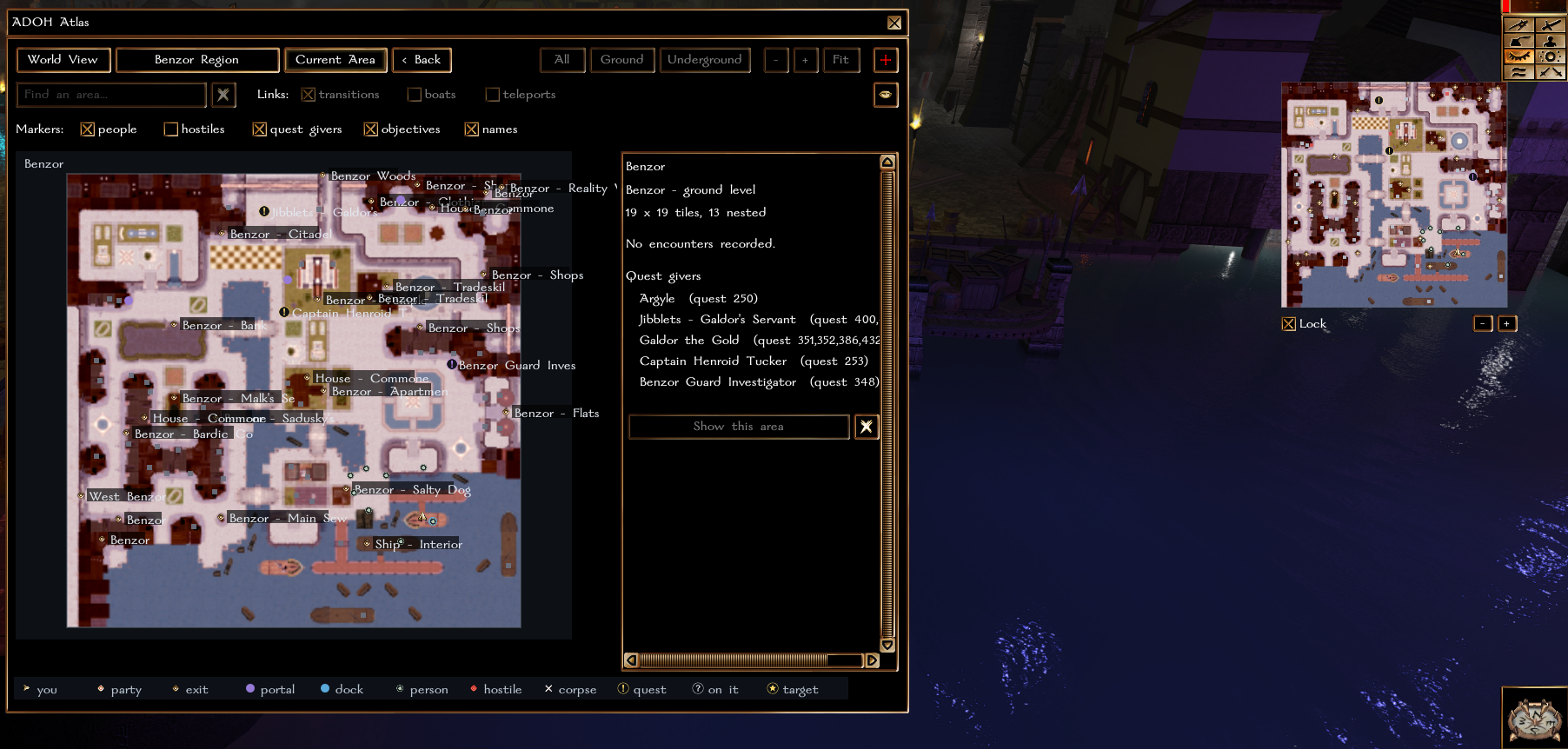
- The move icon at the top right opens a small map you can leave on screen while you play. - and + resize it, Lock pins it in place and hides its title bar so it takes as little room as possible.
- It remembers where you put it, for every character on your account (one save per device type, so desktop will always have the same position, and mobile will have its own position), and remembers whether it was open when you logged out.
If you prefer the old one
The Player Menu has a RESTORE base-game World Map option, and the -oldmap command does the same thing.
There is also a web version, at adawnofheroes.org/map – the same data, in your browser, with the same routing and the same guide.
Crafting and Gathering
GTS has had the largest pass since it landed.
Gathering is now about skill and tools only, not damage
- Yield is decided by how cleanly you work and what you work with – your Craft: Harvesting rank and your tool's material tier. Damage-scaled yield is gone, and no ability score is read anywhere in gathering or crafting any more: ability reaches the system only through the skill rank.
- A tool at the resource's own tier pays full. Four tiers below it and you cannot work the node at all - and your Craft: Harvesting rank is scored the same way, one band per 10 points.
- Anything you can open at all pays a salvage floor, so an untrained player with a good tool does not smash a mithral vein for nothing.
- Gathering is faster with skill: 6 seconds untrained, down to 1 second at rank 91 or above. The tool deliberately shaves nothing – it already decides the haul.
- Yields settle when the node breaks, not when the pile is looted.
- Herbs are gathered with a tool like everything else, and a herb you cannot work is now turned down on the click rather than after you have walked to it. The walk to a node your tool cannot work is called off before you take it.
- Any ordinary weapon of the right shape stands in for a gathering tool, at half rate. Nobody should have to carry a second hammer to break the rock they are standing next to – a sword is still no use against a tree.
The three craft skills
Each of the three now keys off its own ability and does one job:
| Skill | Ability | What it does |
|---|---|---|
| Craft: Harvesting | Strength | gathering yield and speed |
| Craft: Mastery | Intelligence | masterful chance |
| Craft: Speed | Dexterity | craft time |
- Masterful chance is half your Craft: Mastery rank, as a percentage. A masterful item counts one tier higher.
- Masterful crafting is gated on the blueprint, and throwing weapons can be masterful now. Containers cannot.
- The in-game skill descriptions and the crafting help entry have been rewritten – every one of them was describing the old formulas.
New Tier 4 Craftable Items
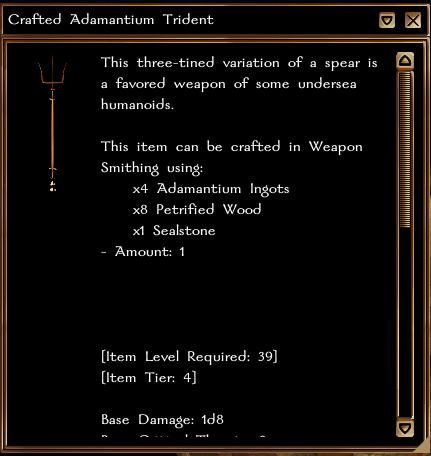
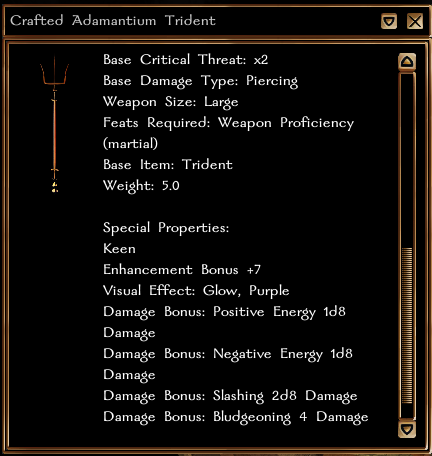
Adamantium (metal), petrified wood (wood) and duskbell (dye) join the ladders as materials to allow the crafting of Tier 4 items (on the same level of Epic "Purple" items).
Skinning and leather
- Skinning works on a carcass the quarry leaves behind. Kill something hided and it leaves a visible carcass where it fell. Bash it to start skinning; an ordinary click still just loots it.
- Skinning speed scales with your harvesting skill.
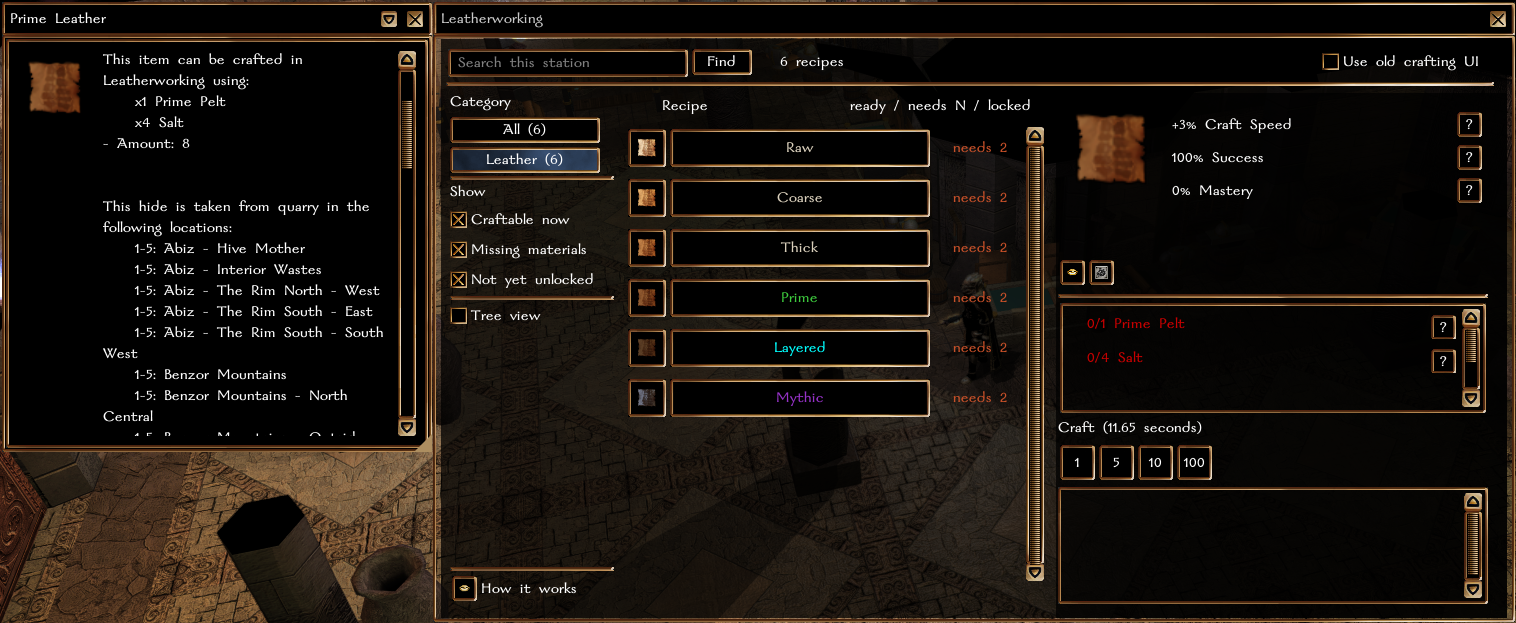
- Leather now runs six graded tiers – Raw, Coarse, Thick, Prime, Layered and Mythic – each tanned from a pelt of the same grade, replacing the single flat leather that 249 recipes used. The three old flat pelt grades become six tiered ones.
- The crafting UI tells you where a hide can be found – every area a given pelt can be taken in, listed the way every other resource lists its sources.
- GTS no longer generates animals procedurally; some low-level animals have been put back into the world as ordinary encounters. Many more races are now skinnable (including dragons!).
- Your old generic GTS leathers have been migrated and split progressively into the new scaling leather items.
The crafting bench
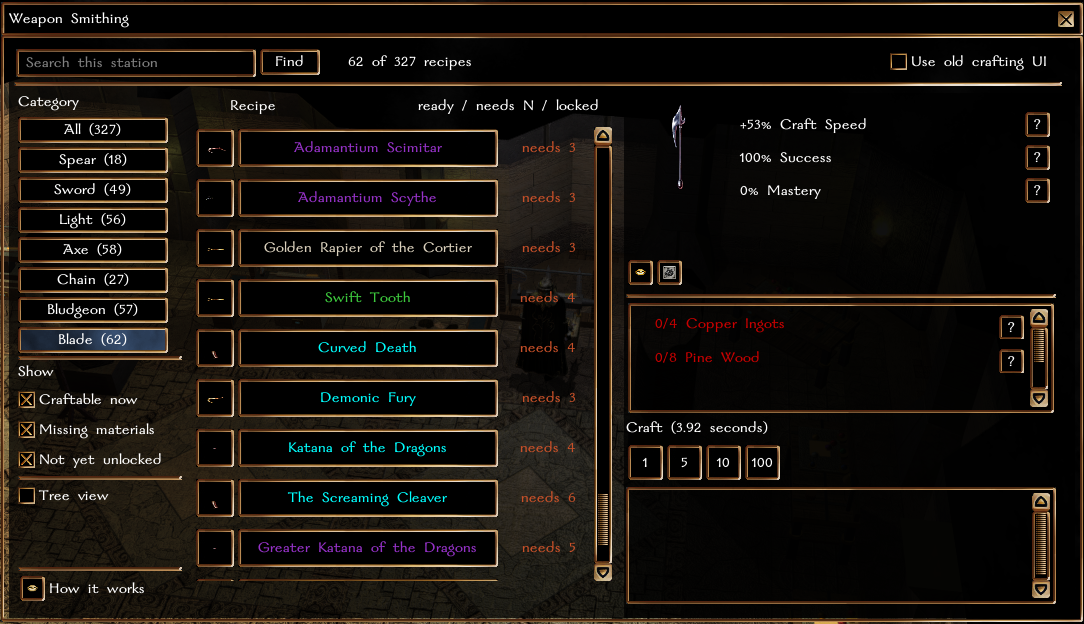
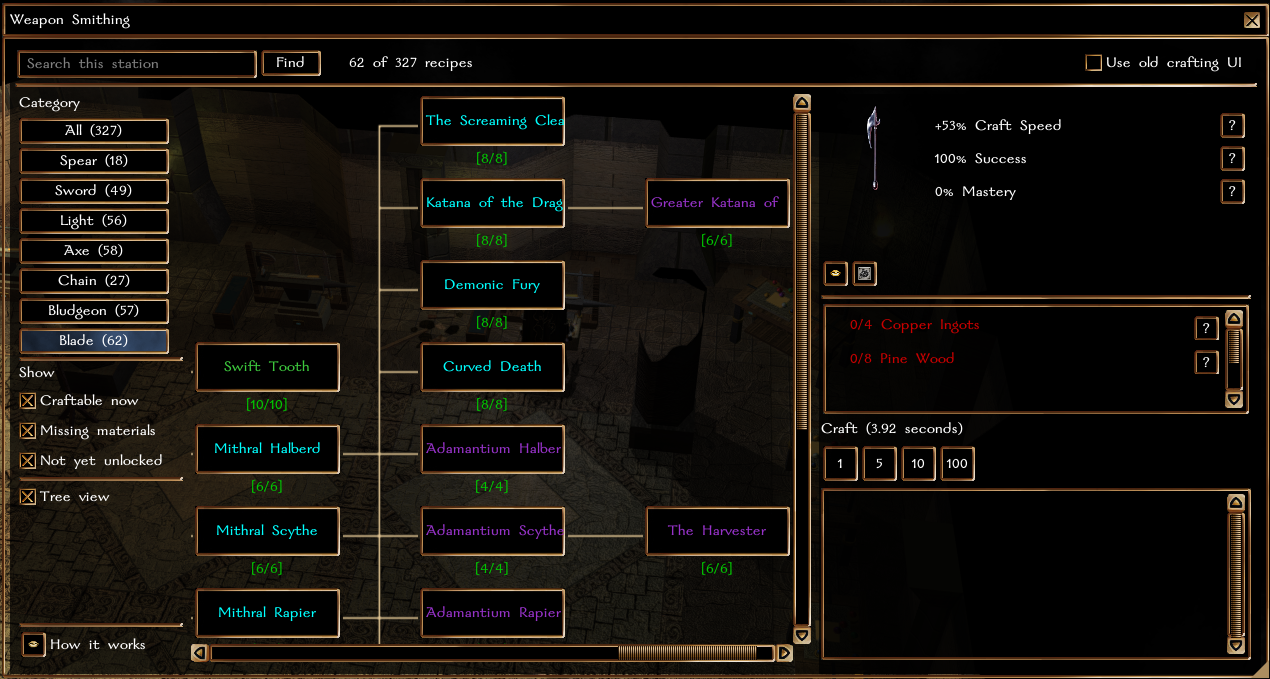
- New crafting stations UI, with a searchable recipe list, real icons and proper row sizing. The old crafting tree is still there and you can switch back if you want to.
- The bench reopens in the view you left it, and remembers its position and size for your whole account – as does your crafting progress, which is now per account rather than per character.
- Categories are ordered by their material ladder, not by rarity, and the tree's node names are coloured by the item tier they produce.
- A "How it works" page explains the forge and the bench in the window itself.
- A recipe you have not unlocked is refused, and the window says so.
- Recipes can require an ingredient without consuming it – that is how the recipe notes below work.
- Examine a resource node and it tells you what it is. Every gathering resource now has an in-game description and a portrait that fits it.
Crafting stations
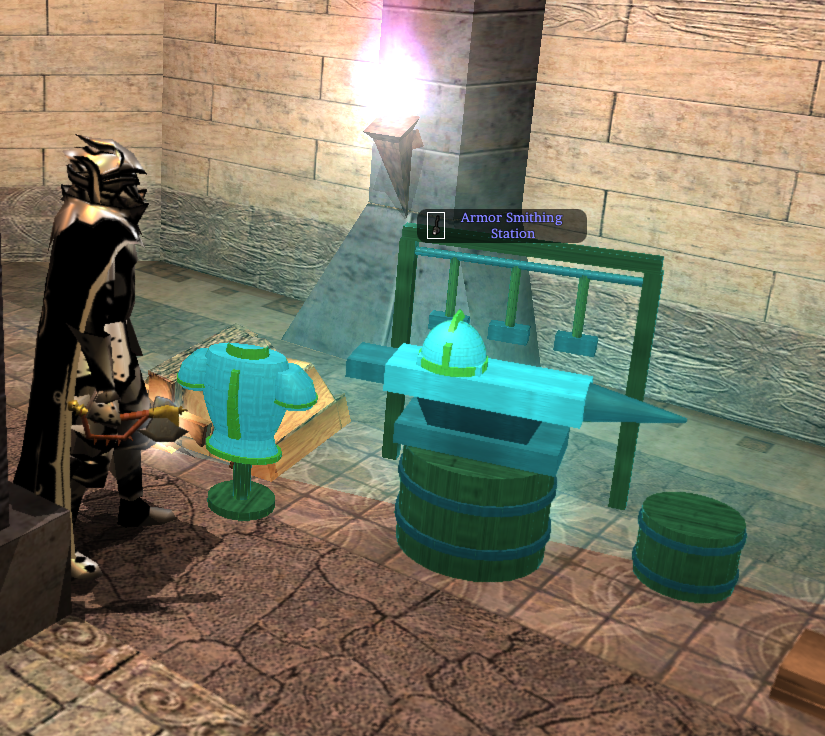
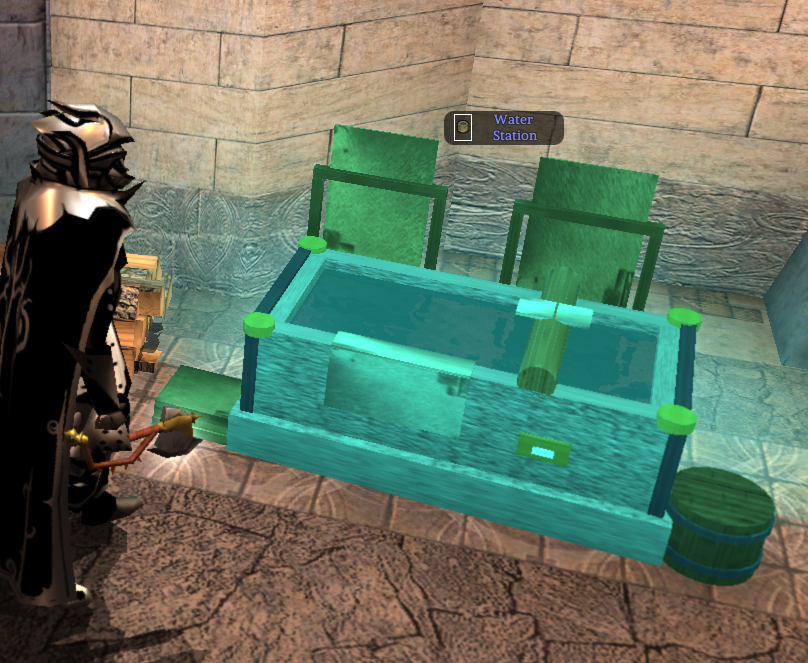
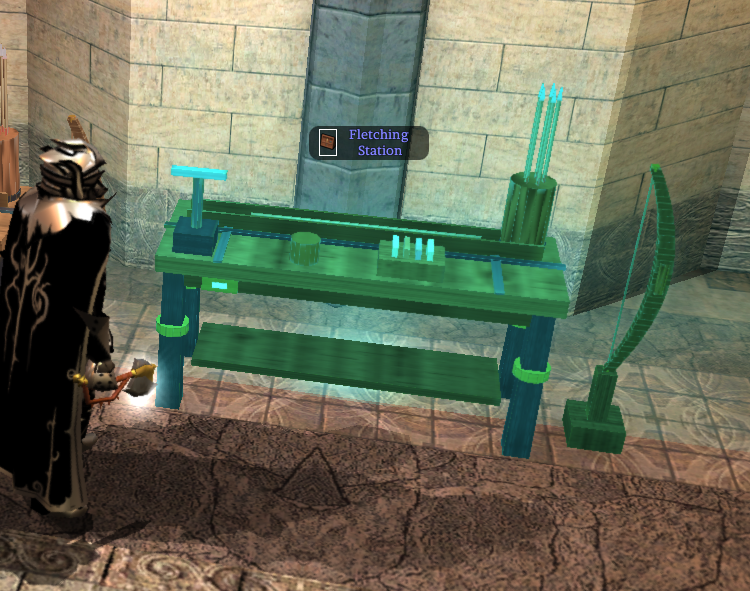
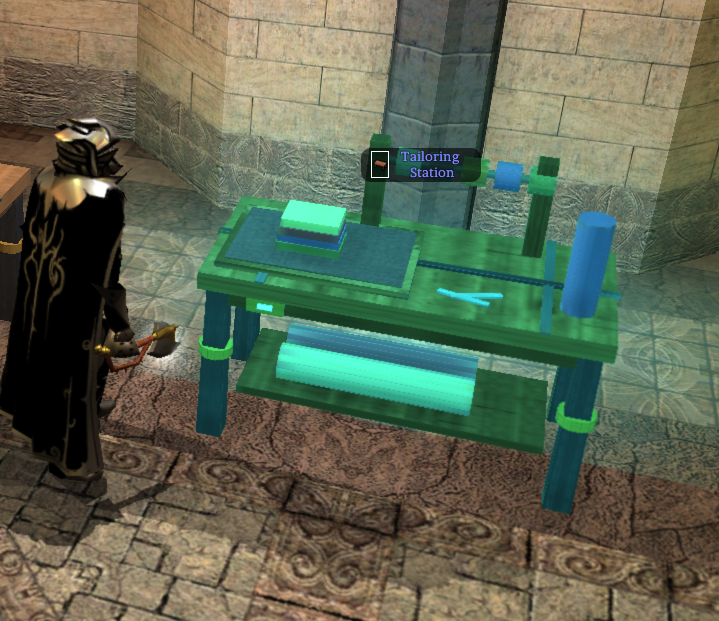
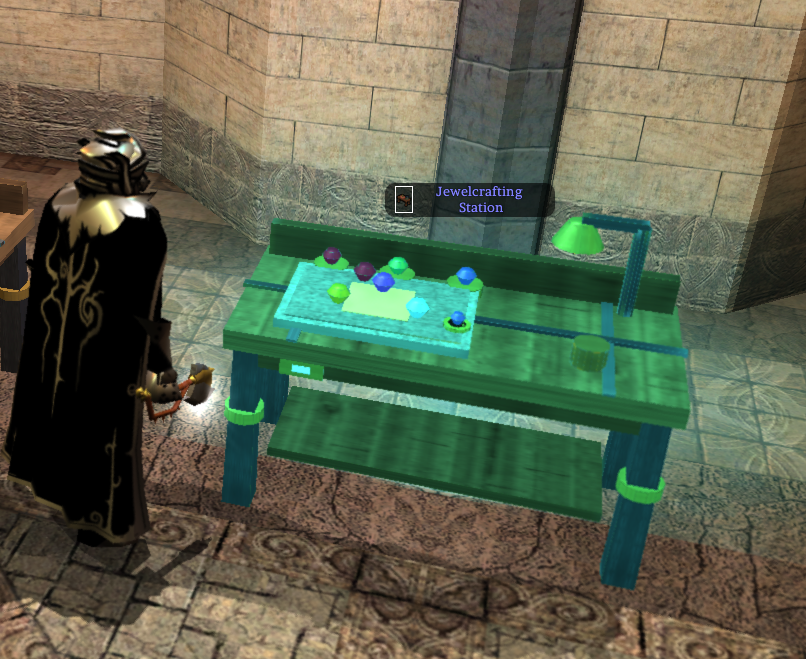
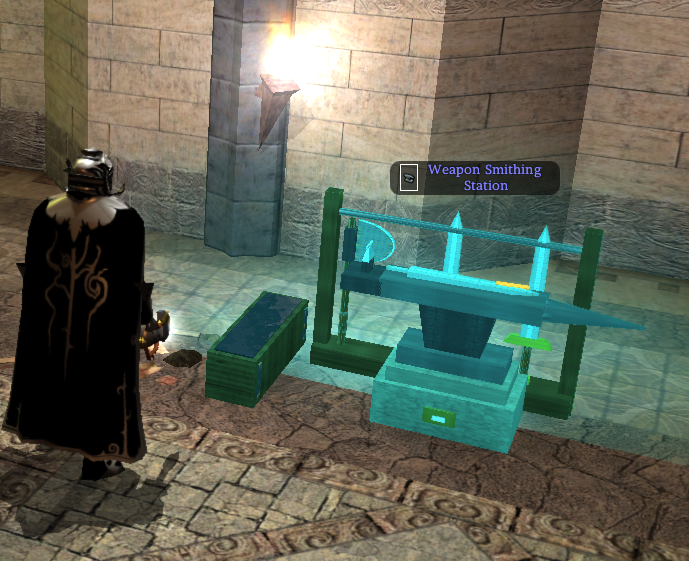
All six GTS crafting stations have been rebuilt – textured from real base-game art, smoothed, with their own materials per station, a tanning trough with its own model and animated water, and hides that sit on the basin instead of through it. You can no longer walk into the tables, and the front of the anvils is clear.
The ATS uniques recipe items are back, as 45 recipes
Every named one-off from the retired ATS crafting system that still had a blueprint has been rebuilt as a GTS recipe – 45 items across all five trades, with their appearance, colours and armour parts carried over so a ported unique still looks like itself. Each hangs off a material rung in its own tree and gates on full mastery of its parent.
21 of them additionally need a recipe note, either burned at each craft or merely held. Notes drop from seven bosses – Gorgoroth, Singe, Glondar, Sangrolu, the Archer, the Plague Bringer and the Elder Wyrm – and six of them are stocked on the four Black Market sheets. A failed craft hands the recipe back.
The 64 old ATS recipe notes are removed, and an old ATS unique you still hold is migrated onto its GTS replacement on login – unless you made it vengeful, in which case it is left exactly as it is.
Trade Hall pricing
- A crafted item is now priced by what it is made of, plus how far up its line the recipe sits – not by how long it takes to craft. Craft duration used to be 82 to 95 percent of every price, which put a mithral full plate at less than twice a mithral dagger despite eating fourteen ingots against one. The median crafted item moves about two percent; what moves is the spread. A full plate is up two and a half times, a dagger down by half.
- Ammunition and thrown weapons are priced apart. The engine was valuing an enchanted arrow as an enchanted weapon and charging that for all ninety-nine in the quiver – a stack of mithral arrows cost 303,138 gold and sold back for 28,314. That stack is now 46,434 to buy and 22,651 to sell.
Events and Leaderboards
A full event and leaderboard system arrives, run by DMs.
- Four event types: Time Trial (solo or party) and Mob Hunt (solo or party). A Time Trial is scored on your best run; a Mob Hunt accumulates points for mobs, bosses, objectives and items.
- An in-dungeon HUD shows the live top five, your own standing and a run clock, updating as you play.
- The HUD can be dragged around behind a Move tick box, and hiding a line gives its space back.
-hudhides or shows the top list, leaving your own standing on screen.-clockhides or shows the run clock.
- The full leaderboard, with
-cls, opens from anywhere and shows the whole board rather than the top five. - You are ranked as an account, and counted as a character. One person holds one row however many characters they enter with, and the row names the character that set the score.
- A party is the competitor in party events, not each attempt.
- Events are announced on Discord: when one starts, when a record falls, and the final standings when it ends.
- An event survives a server restart. Everything is rebuilt from the events table on module load.
- An event can carry its own player cap, level cap, gear restriction and dungeon cooldown override for as long as it runs, and events end on their own deadline.
- Every run is archived, and a snapshot is published before every reboot.
Dungeons and Instances
- The run clock starts when you cross the start trigger, not when the instance is created. Start triggers have been added to every dungeon for you to be able to enter, prepare, and then start the dungeon with enough time.
- In event mode, entering forces a rest and restores your feats, so every attempt begins on the same footing.
- The clock stops at the finish, and a finished party's identity is no longer reused.
- Dungeon cooldowns are now spoken the way you read them – "3 hours", "90 minutes", "45 minutes". Before this, 90 minutes printed as "1 hours", a remaining wait of an hour and a second told you "2 hours left", and a 27-minute event cooldown announced you were bound for "0 hours".
- The dungeon boss check is now a status window rather than a chat dump, and opens from the Player Menu.
- The dungeon list refreshes while the window is open.
- Dungeon and quest reward windows speak in tiers, and the reward icons moved onto the tier ramp.
- New dungeon teleport waypoints have been added, to solve the teleport issues in front of some dungeon entrances, and the entrance tags in conversations were corrected so they send you where they say they do.
Hardcore
- Milestones are announced to the server, not only to Discord and to the character they happened to: a hardcore character dying, losing its status, being raised by a balm, and reaching levels 20 and 40.
- The Hall of Fame UI has been improved, and now is paged and searchable instead of listing every character at once. Search and both filters sit on one bar, the totals moved down beside the page navigator, and the rows were trimmed so a page fits.
Classes, Spells and Skills
- Level 0 spells are now unlimited. Cantrips and orisons never expend a slot, for every class – Resistance, Light, Virtue, Flare, Ray of Frost and the rest are yours as often as you care to cast them, and you no longer memorise them at the cost of something you actually need. A metamagic version is a different matter: it occupies the real higher-level slot it takes up, and still spends it.
- Every feat with a minimum spell level requirement is now validated at level up, not just Empower, Maximize and Quicken. The base game skips that check entirely once a character has a Warlock level. The error message now names the offending feat and the level of spells you would need to cast.
- Animal Empathy duration changed again. It is now 1 turn per combined Druid + Ranger + Shifter level, plus 2 turns per 5 ranks of Animal Empathy. Investing in the skill itself now buys duration, where before only class levels did.
- Summons: the pool of spells a unique creature can be buffed with was changed to avoid spell immunity walls.
- Eldritch Blast bonus damage now reads the single highest permanent source plus the set bonus one, rather than summing every equipped source.
Experience
The XP table has been adjusted and fixed in many parts, and is now generated from a curve instead of being hand-set cell by cell, and the old one had drifted badly:
- One row paid less XP for a harder creature (at level 24, CR 29 paid 475 and CR 30 paid 400).
- 28 cells paid a higher-level character more for the same CR.
- The same CR gap was worth +88% at level 5 but only +22% at level 20.
- Above CR 40 the bonus was flat and unbounded, so a CR 2155 kill paid 2715 XP while a CR 45 boss paid five more than a CR 40 one.
Both consistency rules now hold across the whole table: no cell pays less for a higher CR, and no cell makes more progress for a higher level. Levelling pace over a full 1 to 40 run is unchanged (-0.2%). Kill XP above CR 40 follows the same curve rather than a flat bonus, and an ECL party averaging over level 45 no longer reads off the end of the table and earns nothing.
Stores
All in-game stores have been reworked. Every merchant now opens a shared store whose stock is generated from a table, instead of each one carrying its own frozen copy. It fixes something players have been living with for years: five shops never kept what you sold them. Their lookup failed every time, so the game quietly built a brand new shop on each conversation and anything you had sold was gone by your next visit. Two NPCs selling the same goods now genuinely share stock, and restocking works the same way everywhere.
- Sell prices are capped per store. The module's loot is worth far more than its gold economy can absorb – the median loot-table item value is around 135,000 gold and the top one 21 million, which at a 35% markdown is a seven-figure payout for one drop. Every store that pays anything now has a ceiling on what it will pay for a single item: higher for fences (who pay 10-20% anyway), lower for weapon smiths, and far lower for food, inns and clothiers. The sale still goes through, only the payout is clamped. Your Appraise skill still influences how much you get from an item, but it is also subject to the new payout clamp.
- One price per shop for nordock relics and socketables. The nordock shelf goes flat at 150 Epic Tokens and the socketable shelf at 300 – they were splitting shields, helmets and bracers off from identical goods for no reason anyone could name. 300 also puts socketables where they can be compared against the scrap forge.
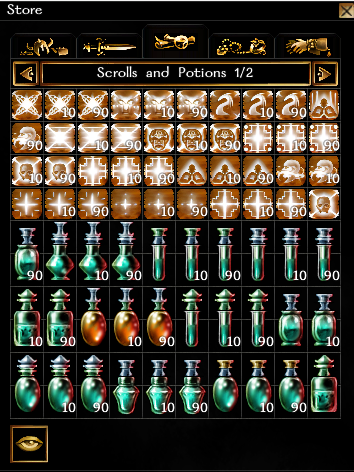
- Stackable consumables are sold in three sizes. Food, potions, scrolls, healing kits and the rest are now stocked as 1, 45 and 90 on every shelf, so you buy the amount you actually want instead of clicking the same line ninety times. Craftable potions and scrolls reach 90 too.
Quests
A full pass over all 455 labelled quests, because nothing in the quest system tells you where to go except the quest text itself.
- Wrong targets corrected in 20 quests. Two of them were off by the length of an entire area – one put a camp beside a temple that sits at the opposite end of a 310-metre strip, and two more named a neighbouring area as though it were the one you wanted.
- Directions added where there were none, across the Hunting Heads, Objects of Evil and Abiz chains.
- 55 multi-kill journals gained their [KILL n] / [DESTROY n] note, and 12 journals regained a bearing their own pickup text already gave.
- All eight henchman-level-unlock quests now state the cap they raise in the in-progress journal entry – the entry you read while deciding whether the detour is worth it, and the one place the reward was missing.
- One quest had no completion journal at all; another told a player who had already finished to get on with it; one asked for lizards, chased crawlers and counted both without saying so.
- Around 440 spelling and name normalisations, and 115 area-name and NPC-name corrections in the quest tables.
- Pet rewards now show in the Quest Browser. A quest granting a pet showed nothing at all anywhere, so nothing told you it existed.
- 38 broken area transitions repaired, and doors relinked.
Character deaths
- Failing the character validation check no longer deletes an existing character. It is sent to Purgatory instead, where you can reroll or deposit XP straight from the conversation. Only a brand-new character, or a test character, is still refused outright.
- No XP bank fee is charged on a Purgatory deposit.
- A henchman resurrecting someone no longer gets stuck. Its pending actions are cleared before it walks to the corpse, so one that was already busy does not freeze halfway through.
Character Sheet
- Feats granted by your equipment and by running effects are now listed, marked as "Item" or "Spell" in the level column. They were not part of the known-feats list and appeared nowhere.
Pickpocketing
- What you can steal is now decided by item tier – anything below tier 3 – instead of a long list of individual flags, which had drifted out of step with what was actually valuable.
- An epic thief carries five times the weight limit, up from three.
The Website
Four things that live outside the game went live over the same period.
- The Armory – a public page per account and per character: race, alignment, classes, statistics, skills, feats, and the equipment your character was wearing when it was last saved, plus its dungeon runs and clears. It also carries the bestiary, a page per creature with who has killed it and how often, and per-dungeon fastest-clear leaderboards. Accounts can be marked private from your Player Menu.
- A creature's death is credited to everyone in the party who was there, not only to whoever struck last: in the party, in the same area, within 50 metres. Being dead does not disqualify you. Nothing is recorded in the arena.
- The world map – the Atlas in your browser, with the same routing, the same markers and a guide of its own.
- The Build Creator – a character planner that replaces the old spreadsheet. It runs entirely in your browser, needs no account, stores nothing, and a build lives in its own shareable link.
- The wiki – the knowledge base has been migrated and rebuilt, with generated pages for classes, feats, skills, spells, items and creatures kept in step with the game's own data, plus all 129 past patch notes.
Misc
- Account and character names now refuse differences you cannot see – a leading space, a trailing space, or two spaces in a row – and name matching ignores case.
- The mighty Maurizio World Boss got his model size adjusted, and can be fought as a real world boss now
- Sounds added to the Trommel woods.
- A duplicate Golden Mace blueprint that shared another item's tag is removed.
- The game's content is served from a new host. Nothing to do on your side; your client is pointed at it automatically.
- Added socketable Torches, 6 slots in line with shields and bracers.
- Crafting a wand spends one blank wand, not the whole stack you were carrying.
- The bone wand stacks now, and is stocked like everything else that stacks.
Fixes
- A vampire's sunlight check read only the cloak and belt slots; it now sweeps every slot.
- A felled tree pays out once and no longer rocks back as it goes over.
- The pets window's dropdown and button clipping is fixed, and the pets window now matches the mounts window.