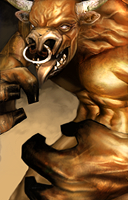
Apis Reborn
- RaceDwarf
- ClassesBard 5Pale Master 19Red Dragon Disciple 14
- Level38
- AlignmentChaotic Evil
Biography
APIS
In ancient Egyptian religion, Apis or Hapis, alternatively spelled Hapi-ankh, was a sacred bull worshiped in the Memphis region, identified as the son of Hathor, a primary deity in the pantheon of ancient Egypt. Initially, he was assigned a significant role in her worship, being sacrificed and reborn. Later, Apis also served as an intermediary between humans and other powerful deities (originally Ptah, later Osiris, then Atum).
The Apis bull was an important sacred animal to the ancient Egyptians. As with the other sacred beasts Apis' importance increased over the centuries. During colonization of the conquered Egypt, Greek and Roman authors had much to say about Apis, the markings by which the black calf was recognized, the manner of his conception by a ray from heaven, his house at Memphis (with a court for his deportment), the mode of prognostication from his actions, his death, the mourning at his death, his costly burial, and the rejoicings throughout the country when a new Apis was found. Auguste Mariette's excavation of the Serapeum of Saqqara revealed the tombs of more than sixty animals, ranging from the time of Amenhotep III to that of the Ptolemaic dynasty. Originally, each animal was buried in a separate tomb with a chapel built above it.
History of worship
Worship of an Apis bull, experienced by ancient Egyptians as holy, has been known since the First Dynasty in Memphis, while worship of the Apis as a proper god, at least according to Manetho's Aegyptiaca, seems to be a later adoption, purportedly started during the reign of king Kaiechos (possibly Nebra) of the Second Dynasty.
Apis is named on very early monuments, but little is known of the divine animal before the New Kingdom. Ceremonial burials of bulls indicate that ritual sacrifice was part of the worship of the early cow deities, Hathor and Bat, and a bull might represent her offspring, a king who became a deity after death.[citation needed] He was entitled "the renewal of the life" of the Memphite deity Ptah: but after death he became Osorapis, i.e. the Osiris Apis, just as dead humans were assimilated to Osiris, the ruler of the underworld. This Osorapis was identified with Serapis of the late Hellenistic period and may well be identical with him. Creating parallels to their own religious beliefs, ancient Greek writers identified Apis as an incarnation of Osiris, ignoring the connection with Ptah.
Apis was the most popular of three great bull cults of ancient Egypt, the others being the cults of Mnevis and Buchis. All are related to the worship of Hathor or Bat, similar primary goddesses separated by region until unification that eventually merged as Hathor. The worship of Apis was continued by the Greeks and after them by the Romans, and lasted until almost 400 CE.
Herald of Ptah
This animal was chosen because it symbolized the courageous heart, great strength, and fighting spirit of the king. Apis came to being considered a manifestation of the king, as bulls were symbols of strength and fertility, qualities that are closely linked with kingship. "Strong bull of his mother Hathor" was a common title for Egyptian gods and male kings, being unused for women serving as king, such as Hatshepsut.
As early as the time of the Narmer Palette, the king is depicted with a bovine tail on one side, and a bull is seen knocking down the walls of a city on the other.
Occasionally, Apis was pictured with the sun-disk symbol of his mother, Hathor, between his horns, being one of few deities ever associated with her symbol. When the disk was depicted on his head with his horns below and the triangular marking on his forehead, an ankh was suggested. That symbol always was closely associated with Hathor.
Early on, Apis was the herald of Ptah, the chief deity in the area around Memphis. As a manifestation of Ptah, Apis also was considered to be a symbol of the king, embodying the qualities of kingship. In the region where Ptah was worshiped, cattle exhibited white patterning on their mainly black bodies, and so a belief grew up that the Apis calf had to have a certain set of markings suitable to its role. It was required to have a white triangular marking upon its forehead, a white Egyptian vulture wing outline on its back, a scarab mark under its tongue, a white crescent moon shape on its right flank, and double hairs on his tail.
The calf that matched these markings was selected from the herds, brought to a temple, given a harem of cows, and worshiped as an aspect of Ptah. The cow who was his mother was believed to have conceived him by a flash of lightning from the heavens, or from moonbeams. She also was treated specially, and given a special burial. At the temple, Apis was used as an oracle, his movements being interpreted as prophecies. His breath was believed to cure disease and his presence to bless those around with strength. A window was created in the temple through which he could be viewed and, on certain holidays, he was led through the streets of the city, bedecked with jewelry and flowers.
https://en.wikipedia.org/wiki/Apis_(deity)
In ancient Egyptian religion, Apis or Hapis, alternatively spelled Hapi-ankh, was a sacred bull worshiped in the Memphis region, identified as the son of Hathor, a primary deity in the pantheon of ancient Egypt. Initially, he was assigned a significant role in her worship, being sacrificed and reborn. Later, Apis also served as an intermediary between humans and other powerful deities (originally Ptah, later Osiris, then Atum).
The Apis bull was an important sacred animal to the ancient Egyptians. As with the other sacred beasts Apis' importance increased over the centuries. During colonization of the conquered Egypt, Greek and Roman authors had much to say about Apis, the markings by which the black calf was recognized, the manner of his conception by a ray from heaven, his house at Memphis (with a court for his deportment), the mode of prognostication from his actions, his death, the mourning at his death, his costly burial, and the rejoicings throughout the country when a new Apis was found. Auguste Mariette's excavation of the Serapeum of Saqqara revealed the tombs of more than sixty animals, ranging from the time of Amenhotep III to that of the Ptolemaic dynasty. Originally, each animal was buried in a separate tomb with a chapel built above it.
History of worship
Worship of an Apis bull, experienced by ancient Egyptians as holy, has been known since the First Dynasty in Memphis, while worship of the Apis as a proper god, at least according to Manetho's Aegyptiaca, seems to be a later adoption, purportedly started during the reign of king Kaiechos (possibly Nebra) of the Second Dynasty.
Apis is named on very early monuments, but little is known of the divine animal before the New Kingdom. Ceremonial burials of bulls indicate that ritual sacrifice was part of the worship of the early cow deities, Hathor and Bat, and a bull might represent her offspring, a king who became a deity after death.[citation needed] He was entitled "the renewal of the life" of the Memphite deity Ptah: but after death he became Osorapis, i.e. the Osiris Apis, just as dead humans were assimilated to Osiris, the ruler of the underworld. This Osorapis was identified with Serapis of the late Hellenistic period and may well be identical with him. Creating parallels to their own religious beliefs, ancient Greek writers identified Apis as an incarnation of Osiris, ignoring the connection with Ptah.
Apis was the most popular of three great bull cults of ancient Egypt, the others being the cults of Mnevis and Buchis. All are related to the worship of Hathor or Bat, similar primary goddesses separated by region until unification that eventually merged as Hathor. The worship of Apis was continued by the Greeks and after them by the Romans, and lasted until almost 400 CE.
Herald of Ptah
This animal was chosen because it symbolized the courageous heart, great strength, and fighting spirit of the king. Apis came to being considered a manifestation of the king, as bulls were symbols of strength and fertility, qualities that are closely linked with kingship. "Strong bull of his mother Hathor" was a common title for Egyptian gods and male kings, being unused for women serving as king, such as Hatshepsut.
As early as the time of the Narmer Palette, the king is depicted with a bovine tail on one side, and a bull is seen knocking down the walls of a city on the other.
Occasionally, Apis was pictured with the sun-disk symbol of his mother, Hathor, between his horns, being one of few deities ever associated with her symbol. When the disk was depicted on his head with his horns below and the triangular marking on his forehead, an ankh was suggested. That symbol always was closely associated with Hathor.
Early on, Apis was the herald of Ptah, the chief deity in the area around Memphis. As a manifestation of Ptah, Apis also was considered to be a symbol of the king, embodying the qualities of kingship. In the region where Ptah was worshiped, cattle exhibited white patterning on their mainly black bodies, and so a belief grew up that the Apis calf had to have a certain set of markings suitable to its role. It was required to have a white triangular marking upon its forehead, a white Egyptian vulture wing outline on its back, a scarab mark under its tongue, a white crescent moon shape on its right flank, and double hairs on his tail.
The calf that matched these markings was selected from the herds, brought to a temple, given a harem of cows, and worshiped as an aspect of Ptah. The cow who was his mother was believed to have conceived him by a flash of lightning from the heavens, or from moonbeams. She also was treated specially, and given a special burial. At the temple, Apis was used as an oracle, his movements being interpreted as prophecies. His breath was believed to cure disease and his presence to bless those around with strength. A window was created in the temple through which he could be viewed and, on certain holidays, he was led through the streets of the city, bedecked with jewelry and flowers.
https://en.wikipedia.org/wiki/Apis_(deity)
Statistics
- 30STR
- 8DEX
- 14CON
- 10INT
- 8WIS
- 14CHA
- 54AC
- 527HP
- 24BAB
Ability scores are the character sheet values, without item bonuses. AC, HP and BAB are as last saved, gear included.
Skills ranks assigned
Points spent, not the total bonus: in game the ability modifier, item bonuses and feats are added on top.
- Spellcraft35
- Tumble30
- Use Magic Device30
- Lore8
Feats 54
- Armor Proficiency (light) L1
- Armor Proficiency (medium) L1
- Armor Skin L26
- Associates Control L1
- Bard Song L1
- Bardic Knowledge L1
- Battle Training vs. Giants L1
- Battle Training vs. Goblins L1
- Battle Training vs. Orcs L1
- Blind-Fight L12
- Bone Skin L4
- Cleave L6
- Collectibles Menu L1
- Curse Song L28
- Darkvision L1
- Deathless Master Touch L29
- Deathless Mastery L29
- Deathless Vigor L16
- Devastating Critical (scythe) L24
- Draconic Armor L6
- Dragon Abilities L7
- Dragon Breath L8
- Energy Resistance, Electrical I L32
- Epic Character L21
- Epic Palemaster L30
- Epic Red Dragon Disciple L23
- Epic Spell: Epic Mage Armor L35
- Epic Spell: Epic Warding L38
- Epic Weapon Focus (scythe) L27
- Great Cleave L9
- Great Strength I L30
- Great Strength II L33
- Great Strength III L36
- Hardiness vs. Poisons L1
- Hardiness vs. Spells L1
- Hit Die Increase (d10) L11
- Hit Die Increase (d6) L6
- Hit Die Increase (d8) L9
- Immunity To Sleep L22
- Immunity to Fire L22
- Immunity to Paralysis L22
- Improved Critical (scythe) L18
- Overwhelming Critical (scythe) L21
- Power Attack L1
- Shield Proficiency L1
- Skill Affinity (Lore) L1
- Stonecunning L1
- Summon Fallen Angel L16
- Tough as Bone L18
- Undead Graft I L17
- Undead Graft II L19
- Weapon Focus (scythe) L15
- Weapon Proficiency (exotic) L3
- Weapon Proficiency (simple) L1
Equipment
 Head Crafted Mithral Coif
- AC Bonus +6
- Ability Bonus Dexterity +5
- Regeneration +2
- Skill Bonus Discipline +8
- Skill Bonus Concentration +8
- Skill Bonus Listen +8
- Haste
- Light Bright (20m)
 Boots Dragon Boots
- Ability Bonus Constitution +5
- Damage Reduction +5 Soak 10 Damage
- Immunity: Miscellaneous Knockdown
- Spell Resistance 16
 Arms Gauntlets of the High Ogre
- Ability Bonus Strength +5
 Right Hand Nordock Craft Scythe
- Damage Bonus Bludgeoning 1d10 Damage
- Damage Bonus Positive Energy 1d10 Damage
- Enhancement Bonus +6
- Keen
- Massive Criticals 1d12 Damage
- Visual Effect Holy
 Left Hand Crafted Mithral Tower Shield
- AC Bonus +6
- Ability Bonus Dexterity +5
- Regeneration +2
- Skill Bonus Discipline +8
 Cloak Cloak of Blackflame
- Immunity: Miscellaneous Level/Ability Drain
 Right Ring Nasher's Ring of Strength
- Ability Bonus Strength +3
 Amulet Pendant of the Elf +4
- Ability Bonus Dexterity +4
- Decreased AC AC Natural Modifier -2
- Immunity: Miscellaneous Mind-Affecting Spells
 Belt Ceremonial Uthgardt Belt
- Immunity: Miscellaneous Death Magic
- Immunity: Miscellaneous Disease
- Saving Throw Bonus: Specific Fortitude +5
Export sheet (text)
Last played 2026-08-04